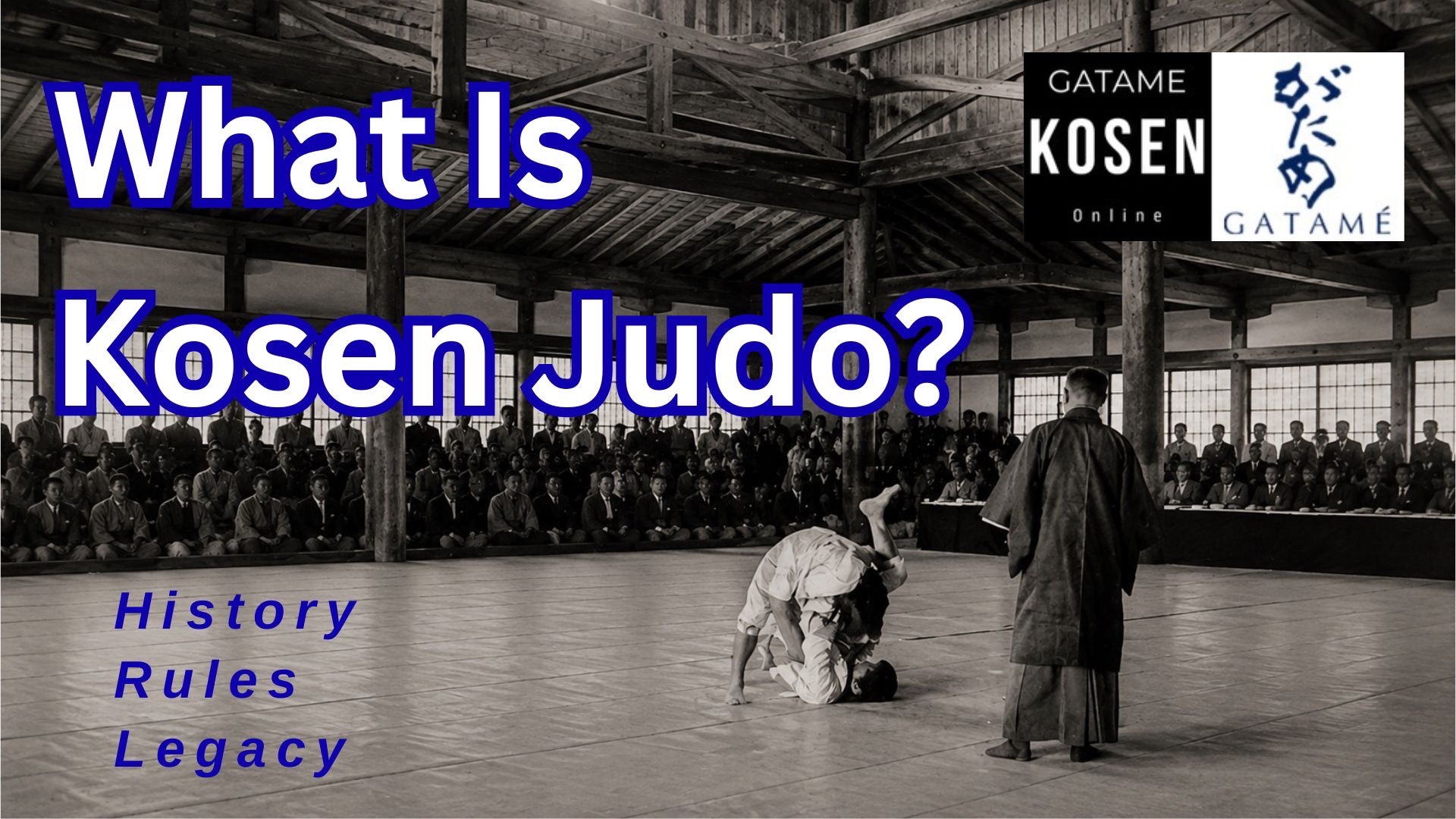
This article explains the history, rules, and legacy of traditional Kosen Judo.
What Is Kosen Judo?
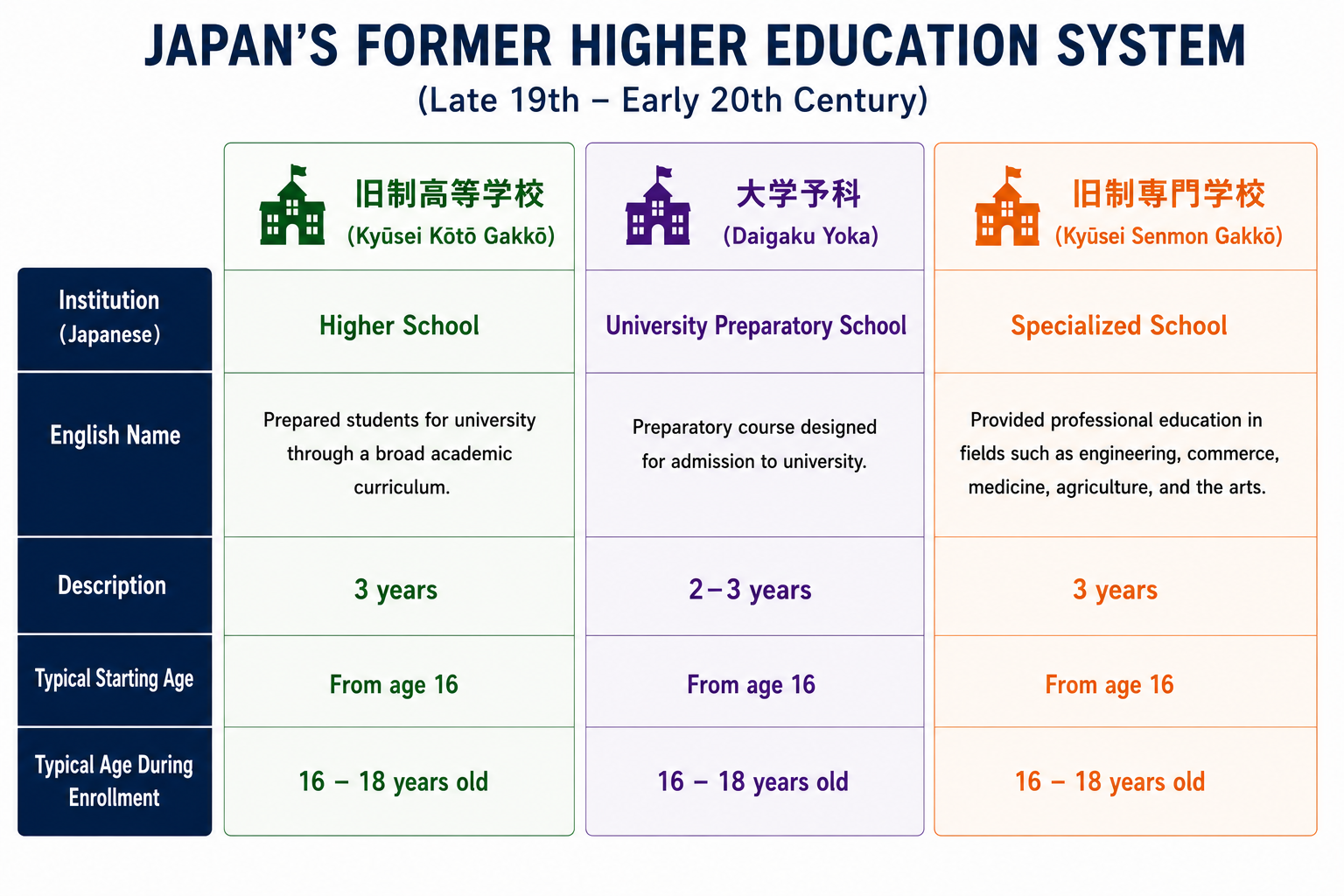
Kosen Judo was a competition held among Japan's former Higher Schools (Kyūsei Kōtō Gakkō), University Preparatory Schools (Daigaku Yoka), and Former Specialized Schools (Kyūsei Senmon Gakkō) from 1898 to 1944.
Unlike standard Kodokan Judo competition rules, Kosen Judo used a unique ruleset that emphasized groundwork (ne-waza), allowing matches to continue on the ground with fewer interruptions.
What Does "Kosen" Mean?
"Kosen" (高専) refers to Japan's former higher educational institutions, including Former Higher Schools, University Preparatory Schools, and Former Specialized Schools, where Kosen Judo competitions were held.
Kosen Judo Rules
- 15 vs. 15 winner-stays-on team competition
- The winner by Ippon remained on the mat to face the next opponent.
- Matches ending in Waza-ari were recorded as Hikiwake (draw).
- Leg grabs were permitted.
- No Jogai (out-of-bounds) penalties.
- If both players left the contest area, the referee called Sonomama (Freeze).
- The competitors returned to the center in the same position.
- The referee then called Yoshi (Continue).
- Hikikomi (pulling an opponent into groundwork) was permitted.
- Only elbow joint locks were allowed.
- Knee bars and heel locks were permitted until approximately 1934.
- Standing submissions were permitted.
| Feature | Kosen Judo | Judo | BJJ |
|---|---|---|---|
| Primary Focus | Groundwork & Transitions | Standing Throws | Groundwork |
| Hikikomi | Allowed | Penalized | Allowed |
| Ground Time | Long | short | Long |
| Osaekomi | Ippon | Ippon | Points |
Kosen Judo History
1898
The first Kosen Judo (then commonly called Jujutsu) competition was held between First Higher School (Ichi-Ko) and Second Higher School (Ni-Ko).
At this time, the rules were still evolving and were revised almost every tournament.
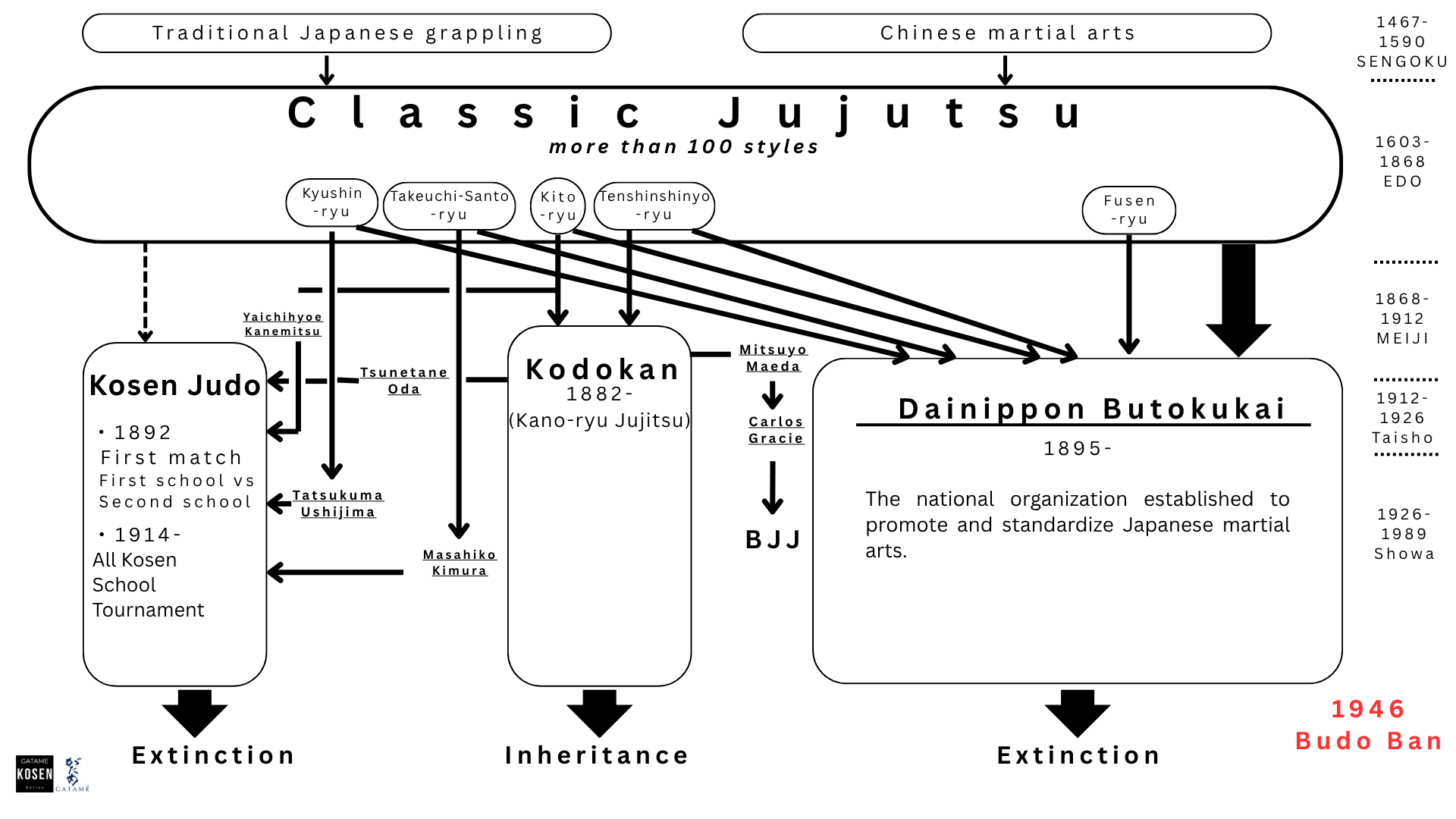
Although Kodokan was founded by Jigoro Kano in 1882, the terms Jujutsu and Kano Jujutsu were still widely used.
↓
1914
The first All Japan Kosen Judo Championship was held in Kyoto.
↓
1921
Triangle choke (Sankaku-jime) was developed and became one of Kosen Judo's signature techniques.
↓
1923
Kodokan officially prohibited Hikikomi in its competition rules.
Most Kosen Judo schools continued using their traditional rules.
↓
1944
The final Kosen Judo Championship was held.
↓
1946
GHQ introduced the Budo Ban, prohibiting martial arts activities in schools, including Kosen Judo.
↓
1947
Japan adopted a new education system.
The former Kosen schools disappeared.
↓
1950
After the Budo Ban was lifted, the tradition continued as Nanatei Judo (Seven Universities Judo Tournament).
Why Is Newaza So Famous in Kosen Judo?
The rules encouraged extensive groundwork.
Because groundwork was rarely stopped, competitors developed highly sophisticated transitions, pins, submissions, and turnovers.
Many famous techniques and tactical systems—including the widespread use of Sankaku-jime (triangle choke)—were refined through Kosen Judo competition.
The winner-stays-on team format also encouraged specialized roles.
Some competitors aimed to score decisive victories, while others focused on securing draws to stop the opposing team's momentum.
As a result, turtle attacks, turnovers, and efficient groundwork became highly developed.
Is Kosen Judo Still Practiced?
The original Kosen Judo competition ended with the disappearance of Japan's former higher education system and Budo Ban.
However, its tradition continues through the Nanatei Judo Tournament (Seven Universities Judo Tournament).
Today, the seven participating universities still compete once a year using rules that preserve many traditional Kosen Judo characteristics.
Has There Ever Been a Kosen Judo Black Belt?
No.
Kosen Judo never had its own independent ranking system.
Before World War II, practitioners received rank promotions from either the Kodokan or the Dai Nippon Butoku Kai.
Today, competitors in the Seven Universities Tournament continue to earn their black belts through the standard Kodokan grading system.
Famous people in Kosen Judo
Tsunetane Oda (小田 常胤)
One of Kosen Judo school coach. He was from Kodokan. His Newaza was called Tsunetame-ryu.
Yahei Kanemitsu (金光 弥兵衛)
One of Kosen Judo school coach who developed Hiza Juji Gatame (Knee bar) and Sankaku JIme. Also he was Kodokan 9th Dan and Butoku Kai Judo Kyoshi.
Tatsukuma Ushijima (牛島 辰熊)
One of Kosen Judo school coach, also Masahiko Kimura coach. He won the All-Japan Judo Championships 3 times in a row.
Masahiko Kimura (木村 政彦)
Kosen Judo competitor Kimura was heavily influenced by instructors such as Tatsukuma Ushijima. He also won the All-Japan Judo Championships 13 times in a row.
What is Gatame Kosen?
Gatame Kosen is a modern judo curriculum inspired by traditional Kosen Judo. It preserves traditional techniques and ne-waza while providing a simple, enjoyable ruleset that can be practiced by judoka and grapplers around the world.
Why Does Gatame Kosen Exist?
Gatame Kosen was inspired by the philosophy and competition rules of traditional Kosen Judo.
Our mission is not to replace Kodokan or IJF Judo, but to preserve an important part of judo history while making its unique ne-waza accessible to practitioners around the world.
1. Preserve Traditional Techniques
Many techniques once used in Kosen Judo are no longer allowed in modern IJF competition.
Gatame Kosen helps preserve and teach techniques such as:
- Morote-gari (Double-leg Takedown)
- Kuchiki-daoshi (Single-leg Takedown)
- Standing submissions
- Ude Tori Gaeshi
- Other traditional techniques and tactical systems
2. A Simple and Enjoyable Ruleset
Inspired by the original Kosen Judo rules, our ruleset encourages continuous action and technical ne-waza.
It is designed to be easy to learn, enjoyable to practice, and suitable for judoka and grapplers of all experience levels.
3. Make Kosen Judo Accessible Worldwide
For many years, learning authentic Kosen Judo required traveling to Japan.
Gatame Kosen provides a structured curriculum that allows practitioners around the world to learn traditional Kosen Judo concepts, techniques, and history—anytime, anywhere.